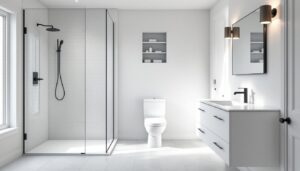
Small bathrooms are tricky, but modern design principles work in your favor. Clean lines, minimal ornamentation, and smart material choices create visual breathing room even in a 5×7 space. The key is treating every square inch as valuable real estate, no wasted corners, no bulky vanities eating floor space, and no design choices that make walls feel like they’re closing in. Modern doesn’t mean cold or sterile: it means intentional. When working with tight quarters, that intentionality pays off in function and feel.
Table of Contents
ToggleKey Takeaways
- Modern small bathroom design prioritizes clean lines and minimal ornamentation to create visual breathing room and make tight spaces feel larger.
- Wall-mounted fixtures like floating vanities and wall-hung toilets expose more floor area, making a cramped bathroom appear more spacious and easier to clean.
- Large-format tiles (12×24 inches or larger) and light color palettes with glossy or semi-gloss finishes reflect light and reduce visual clutter in small bathrooms.
- Strategic layout choices such as corner showers, pocket doors, and curbless designs maximize usable square footage without expanding the actual space.
- Layered lighting with recessed LEDs, vanity sconces, and backlit mirrors combined with proper storage solutions transforms small bathrooms into functional and stylish spaces.
- Water-efficient fixtures meeting WaterSense standards (2.0 gpm or less) align modern design with sustainability while maintaining code compliance.
Why Modern Design Works Best for Small Bathrooms
Modern design strips away the ornate trim, bulky cabinetry, and heavy fixtures that shrink small spaces. Traditional styles often rely on visual weight, thick crown molding, furniture-style vanities with legs, framed mirrors, that works fine in a spacious master bath but overwhelms a compact room.
Modern bathrooms favor wall-mounted fixtures, which expose more floor area and make cleaning easier. A floating vanity, for example, creates the illusion of more square footage because you can see the floor extending underneath. The same principle applies to wall-hung toilets, though those require in-wall carriers and blocking during framing, so they’re easier to install during a gut renovation than a simple refresh.
The modern palette, whites, grays, blacks, and natural wood tones, also plays well with light. Glossy or semi-gloss finishes on tile and cabinetry reflect light instead of absorbing it. Flat-panel cabinet doors and minimal hardware reduce visual clutter. Everything about the aesthetic is designed to keep sightlines open and surfaces uninterrupted, which is exactly what a cramped bathroom needs.
Space-Saving Layout Strategies That Actually Work
Layout is where most small bathroom projects succeed or fail. You can’t change the square footage, but you can rethink how it’s divided.
Corner showers reclaim dead space. A neo-angle shower (the five-sided kind that tucks into a corner) or a quadrant curved unit frees up room for a larger vanity or linen storage. Standard shower bases start at 32×32 inches, but you can find 30×30 or even smaller if code allows and you don’t mind tight quarters. Pair it with a frameless glass enclosure or a single fixed panel to avoid the chunky look of framed shower doors.
Pocket doors are a game-changer when a swinging door eats into your already limited floor space. They require a 2×4 or 2×6 stud cavity to recess into, so check your wall framing. If you’re renovating and walls are open, it’s worth the extra framing work. Barn doors are a trendy alternative, but they don’t seal as well and need clearance on the wall, so weigh aesthetics against function.
Consider a tub-shower combo if you need both. A standard 60-inch alcove tub fits most small bathrooms, and you can tile the surround floor-to-ceiling for a modern look. If you don’t need a tub, ripping it out and installing a curbless shower with a linear drain opens up the room dramatically. Just know that curbless showers require careful waterproofing and proper slope (typically 1/4 inch per foot toward the drain).
Choosing the Right Fixtures and Fittings
Fixtures set the tone, but in small bathrooms, they also determine how much usable space you have left.
Wall-mounted sinks or narrow-profile vanities (18 inches deep instead of the standard 21) give you breathing room. If you go with a pedestal sink, you sacrifice storage but gain floor area, a fair trade in a powder room, less so in a family bathroom where you need to stash toiletries. Trough-style sinks with a single faucet work well for modern aesthetics, though dual-faucet troughs need at least 48 inches of vanity width to avoid crowding.
Toilets come in various footprints. A compact elongated bowl (about 28 inches from wall to front, versus 30+ for standard) saves a couple of inches. Wall-hung toilets are the sleekest option but require an in-wall tank system like a Geberit or similar, which adds cost and must be installed during wall framing. They’re worth it if you’re doing a full gut.
For faucets and showerheads, modern typically means single-lever mixers, matte black or brushed nickel finishes, and low-profile designs. Thermostatic shower valves are a nice upgrade, they maintain water temperature even when someone flushes a toilet elsewhere in the house. Make sure any valve you choose meets WaterSense standards (2.0 gpm or less for showerheads) to stay code-compliant and save on water bills.
Color Schemes and Materials That Open Up Space
Color and material choices either amplify light or swallow it. In small bathrooms, you want the former.
White and light gray are safe bets. Large-format porcelain tile, 12×24 inches or bigger, reduces grout lines and makes floors and walls feel more expansive. Subway tile (3×6 inches) is a modern classic: run it horizontally for traditional, vertically for a more contemporary look. Avoid tiny mosaics on large surfaces: they create visual noise.
A single accent wall in a darker tone or textured material (think 3D wall tile or natural stone) adds depth without overwhelming the space. Many designers recommend small space design approaches that emphasize contrasting textures rather than multiple colors.
Glossy finishes reflect more light than matte, but they also show water spots. Semi-gloss is a practical middle ground for walls. For floors, large-format tiles or luxury vinyl plank (LVP) in a light wood tone can warm up an all-white scheme without darkening the room. Avoid busy patterns or high-contrast grout, those tricks that supposedly add interest usually just make the room feel smaller.
If you’re working with natural stone (marble, quartz, or porcelain slab), book-matching creates a striking feature wall. Waterfall edges on a vanity countertop also read as modern and high-end, though they’re pricier and require a fabricator who knows what they’re doing. Materials like terrazzo and matte tile deliver warmth without sacrificing the clean modern aesthetic.
Clever Storage Solutions for Every Corner
Storage is the Achilles’ heel of small bathrooms. You need places for towels, toiletries, cleaning supplies, and backup toilet paper, all without cluttering countertops or adding bulk.
Recessed shelving (also called niche shelving) is the gold standard. If you’re opening walls, frame out a niche between studs (typically 14.5 inches wide in standard 16-inch-on-center framing) in the shower or above the toilet. Line it with the same tile as your walls for a seamless look. Aim for at least 8 inches deep if you’re using it for shampoo bottles.
Floating shelves above the toilet or next to the vanity add storage without encroaching on floor space. Use brackets rated for the load (most code requires 50 pounds minimum), and mount into studs or use heavy-duty drywall anchors if studs aren’t where you need them.
Mirrored medicine cabinets do double duty: they provide hidden storage and make the room feel larger. Surface-mount models are easier to install, but recessed cabinets (set between studs) look cleaner and don’t jut into the room. Just make sure there’s no plumbing or electrical in the wall cavity before you cut.
Under-sink storage is often wasted because of plumbing. Use stackable bins or a tension rod to hang spray bottles. If you’re replacing the vanity, choose one with drawer inserts or pull-out organizers, drawers are far more functional than cabinet doors in tight spaces.
Lighting Techniques to Make Your Bathroom Feel Larger
Bad lighting kills even the best design. Small bathrooms need layered lighting: ambient (overhead), task (vanity), and accent (niches or toe kicks).
Recessed LED downlights (4-inch or 6-inch cans) provide general illumination without hanging into the space. Space them about 4 feet apart and keep them IC-rated if they’ll contact insulation. Dimmer switches let you adjust mood and save energy.
Vanity lighting is critical. Vertical sconces on either side of the mirror eliminate shadows better than a single bar light above. Mount them at 60-66 inches from the floor (roughly eye level). LED bulbs in the 3000K-4000K range (warm white to neutral) render skin tones accurately without the harsh blue cast of daylight bulbs.
If you have a window, maximize it. Skip heavy curtains: use frosted film or textured glass for privacy while letting light through. If privacy isn’t an issue, leave it bare. North-facing windows give soft, even light all day, while south-facing ones can overheat a small space in summer, consider that when choosing finishes.
Backlit mirrors are increasingly popular in modern bathrooms and add a subtle glow that makes the room feel larger. Installation is straightforward if you have an outlet behind the mirror: otherwise, you’ll need to run power during the rough-in phase. Exploring a variety of design ideas and layouts can help identify lighting schemes that fit your specific bathroom dimensions and window placement.
Conclusion
A small bathroom doesn’t have to feel cramped or compromised. Modern design, clean lines, smart layouts, light-enhancing materials, turns spatial constraints into opportunities for efficiency and style. Focus on the fundamentals: maximize floor visibility with wall-mounted fixtures, choose large-format tiles and light colors, layer your lighting, and build in storage wherever framing allows. The result is a bathroom that works hard and looks sharp, no matter the square footage.